Facing a network of thousands of nodes, the eye sees fragments but struggles to judge the whole. Graph algorithms turn network structure into leads that can be ranked, compared and verified.
From “seeing relations” to “understanding structure”
Relationship graphs make connections intuitive, but as scale grows, purely visual browsing hits a wall. Which nodes deserve attention first? Which accounts control the money path? Which subjects are quiet yet deeply influential? Which nodes actually belong to the same group?
By analyzing the position of nodes and links within the whole network, graph algorithms give explainable, quantitative grounding for these questions. They do not replace professional judgment — they help analysts find what is worth judging, faster.
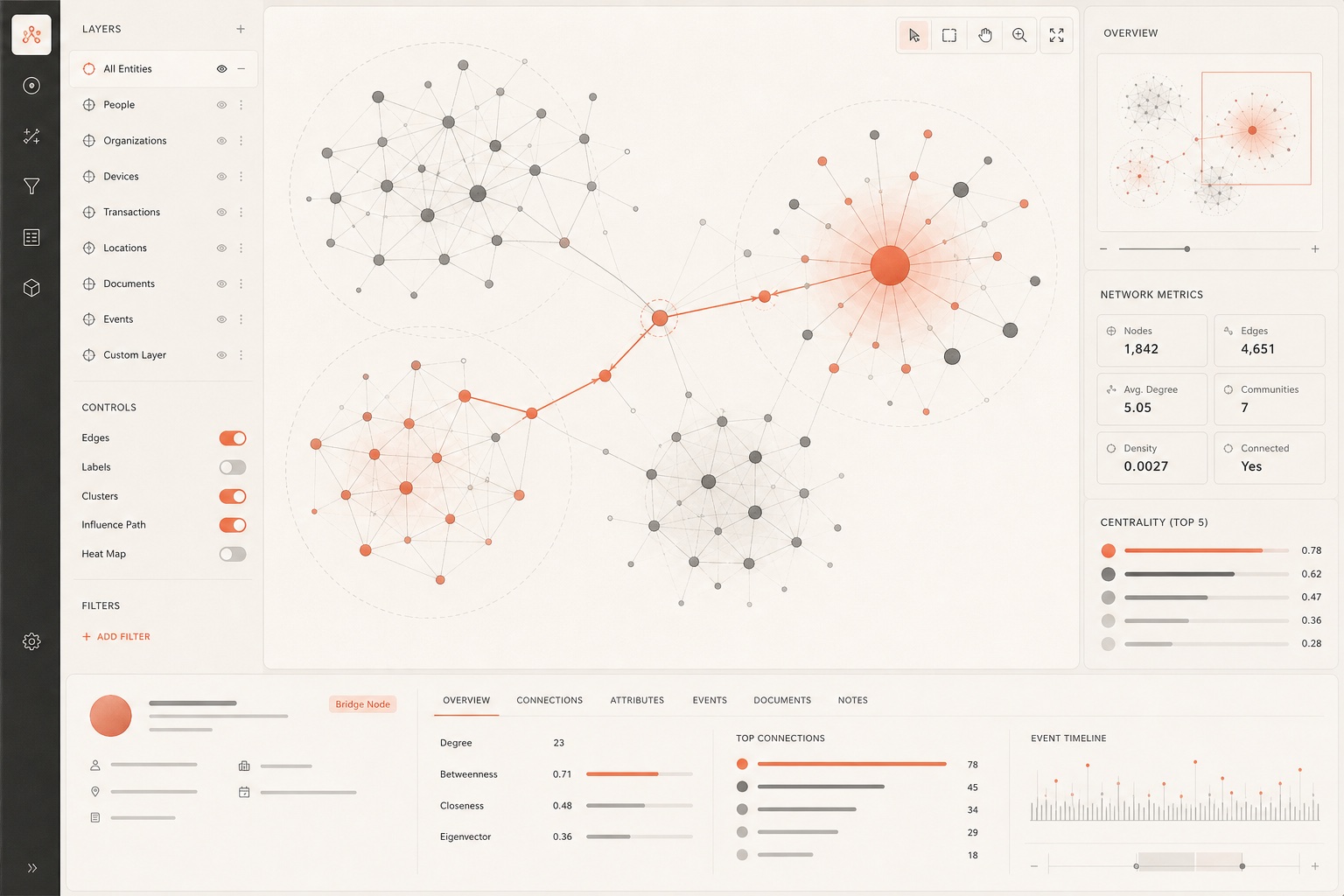
Four core algorithms, four business lenses
Counts a node's direct connections. More connections often mean frequent transactions, broad ties or high activity — good for quickly screening high-frequency subjects.
Measures how many key paths a node sits on. Even with few connections, it may control the channel of funds or information between different groups.
Looks not only at the number of connections but at how important the connected nodes are. It helps surface low-profile yet pivotal controllers in the core chain.
Automatically partitions groups by internal link density, without a predefined member list, helping identify potential gangs and operating units.
Algorithm and human together make investigation
Real-world relationships are far more complex than a mathematical model. A high-frequency account may be a normal hub; a bridge node may have legitimate business reasons. So algorithm results must be cross-checked with original data, business tags, temporal features and domain experience.
K2 puts algorithm results right back into the interactive graph. Analysts can see why a node was flagged, trace original records along a path, switch layouts to observe structure, and keep expanding based on judgment. This “algorithm locates, human verifies, keep asking” loop makes computation truly serve investigation.
The value of graph algorithms is not a mysterious score, but shortening the distance from massive data to the key question.